we walk like Mary

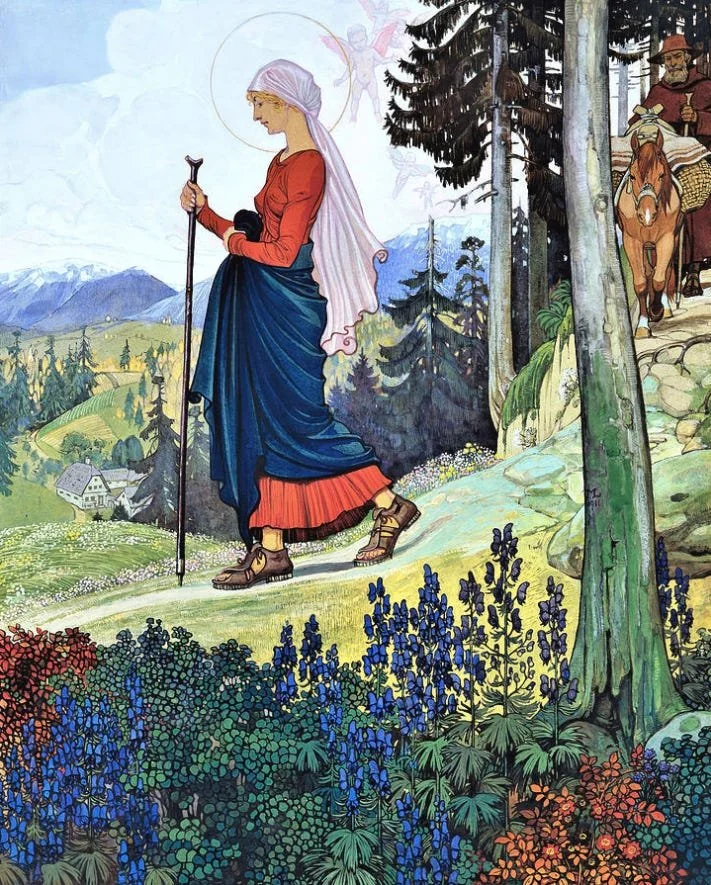
“Walk of Mary Across the Mountains” by Maximilian Albert Josef Liebenwein (1869–1926)

I’m sure we’ve all seen any number of artistic interpretations of the journey of the Holy Family to Bethlehem for the census and the birth of Christ. In most of them, Mary’s fragility as a very-pregnant mother seems to be an important theme: She is typically perched on the couple’s donkey while Joseph tirelessly walks alongside, or is at least leaning heavily on Joseph’s support, if she tries to walk herself. This painting, titled “Walk of Mary Across the Mountains,” struck me as so opposite to those renderings that I first thought – until I noticed Joseph and the burro in the shadows of the upper right-hand corner – that it must be depicting Mary’s visit to Elizabeth, not her trek toward meeting God in tiny-human-baby form.

Perhaps it strikes me especially because I’ve been in this “very-pregnant” state twice in the last six years. I know the immense (perhaps near-impossible) ask that a 70-mile journey on foot would make on an unstable pelvis, split abdominal muscles, and half-capacity lungs. I understand why so many paintings show her riding the donkey – which, granted, wouldn’t have been particularly comfortable, either. Yet in this piece, Maximilian Leibenwein has captured something different in Mary that I also recognize: That state of resigned determination that takes a woman from her already-great discomfort through a period of excruciating travail and into the extraordinary euphoria on the other side.

Toward the end of each of my pregnancies, I didn’t know what scared me more: that I might be pregnant for another three weeks, or that I might not be pregnant for another three weeks. Each option was defined by a different kind of uncertainty and discomfort, but either way, I could not escape the fact that my fate was to endure the uniquely life-upending transition of a birth, sooner or later.

Mary’s baby is coming. The pain is inevitable; the process is inevitable; the birth is inevitable. He is coming. Her body will do the work, and she must only be ready to meet him.

But unique to Mary’s circumstance is that it’s not merely her firstborn son coming; it is her Lord. The Messiah is coming. After millennia of relentlessly inviting his people into his space, God Incarnate invaded ours, bringing heaven to earth and commencing the rebirth of humanity through the birth of Jesus.

Ready or not, the King is coming.

We remember his royal-and-lowly approach in Advent, in part, to remember that the King still approaches us; the King, though come, is also here, and is coming again. He has already-and-not-yet come, already-and-not-yet rescued us, already-and-not-yet glorified us.

How do we approach him? How can we be ready to meet him? Perhaps with a doggedness like Mary’s, as she made the journey toward the “greatly multiplied” pain promised her in Genesis 3:16 for the sake of meeting the snake-crusher of Genesis 3:15. She was at once humble and bold: humble, in her wholehearted submission to God’s use (Luke 1:38); and bold, in her unflinching determination to praise the Lord for the goodness and certainty of his plan for her life, and for her whole people besides (Luke 1:46-55).

We need not have birthed children from our bodies to know what it is to make an arduous trek through certain suffering for the sake of immeasurable joy. This is the story of every saint, every martyr, every follower of Christ – the story of my life and yours. Pain in life, and death at life’s end, are inevitable. But on the other side is Jesus. And with us every moment – though like Mary in Leibenwein’s depiction, we cannot yet see him – is Jesus.

Every day is another step toward the God who has stepped toward us. Every day, a step closer to his presence, a moment nearer to the full realization of his glory. We walk humbly, yet boldly: obeying and praising, walking and singing, enduring and rejoicing. We walk like Mary, across treacherous mountains and valleys of shadow, until at last we see our Lord face-to-face.

God is here

I’m not sure how noticeable it is in this journaling space of sorts, but I’ve been going through what feels like a massive shift in how I understand the Gospel and, really, the Bible in general over the last few years. For so long, I thought of it mostly as a guidebook through the wilderness wasteland of earthly life to the Promised Land of heaven beyond—a view that I think a lot of Christians have, and one that is easily reinforced in our churchly experiences. “Repent and be saved so that you can go to heaven when you die” has been the prevailing message of what has been called the Gospel for many recent decades.

The trouble with such a gospel is that it leaves us there in the wilderness wasteland, waiting around for death. What then is the point of life? Is it any wonder that we’re so often tempted toward either fearful legalism or lawless hedonism when we don’t know what else to do with the intervening years before our salvation is, in our mind, actually realized?

But if the whole story of the Bible informs how I understand the Gospel, then there must be so much more to it than repent, be good, and wait around to die.

In the beginning, God planted a garden paradise where His presence would dwell, and He placed His image bearers within it. They were to cultivate and keep it, and to fruitfully multiply into families of image bearers, working in partnership with a present God to push the borders of Eden wider and wider until His holy garden-temple-kingdom might envelop all Creation.

We know what happens next: Instead of working in cooperation with the plan, the bearers of God’s image rebelled against His wisdom, choosing their own instead, and were consequently banished from His presence.

All this takes place in the first three chapters of Genesis. What then is the rest of the Bible? It’s the story of God’s relentless efforts to remedy the breach and return to dwell among His people—from the wilderness tabernacle to Solomon’s temple to, finally, incarnation in Jesus Christ, Immanuel, God With Us.

He, crowned King over all Creation and then ascending to sit at God’s right hand, sent His Spirit to dwell not only with us but in us. And He has never left.

God is here.

And yet our version of the Gospel seems too often to tell us that we’re just like the intertestamental Israelites, living in a broken and oppressed society, our temple overrun by moneychangers, our God silent, and our only hope in some unknown day when the Messiah might appear or we might die, whichever comes first.

Does that sound like good news?

Contrast this dismal picture with the language of the New Covenant for Israel, described in Ezekiel 36:

Thus says the Lord GOD, “On the day that I cleanse you from all your iniquities, I will cause the cities to be inhabited, and the waste places will be rebuilt. The desolate land will be cultivated instead of being a desolation in the sight of everyone who passes by. They will say, ‘This desolate land has become like the garden of Eden; and the waste, desolate and ruined cities are fortified and inhabited.’ Then the nations that are left round about you will know that I, the LORD, have rebuilt the ruined places and planted that which was desolate; I, the LORD, have spoke and will do it.”

Ezekiel 36:33-36

This is, importantly, a text directed at God’s people Israel, describing the New Covenant that superseded the Mosaic Covenant through the Messiah. It wasn’t written to you and me. But as adoptees into God’s family, we have been grafted into this covenant (Romans 11), and so while the specific renewal of the Holy Land isn’t directed at us or our nation, the imagery remains applicable: desolation gives way to flourishing, desertion gives way to multitudes, waste gives way to fruitfulness. Ruin gives way to Eden. Death gives way to life.

Because for those whose iniquities have been cleansed, God is here, and He is hard at work, partnering with us once more to transform a desolate world into a heavenly kingdom.

Too many of us, including myself a lot of the time, are loitering around the construction site dressed in suit jackets and pearls or collecting signatures on a petition or just sitting on the ground with our head in our hands, waiting for a rescue that has already occurred while the job that still needs doing sits undone.

Yes, it’s slow, dirty, uphill work. It’s discouraging at times to know we will not see its completion during our earthly lives. It’s curiously the richest and poorest vocation simultaneously, the loveliest and the ugliest, the biggest and the smallest; it’s both completely invisible to the untrained eye and a shimmering beacon in the black of night, a city on a hill.

And it’s so much better than whiling our lives away walking circles in the wilderness, trying to attain Pharisaical perfection or giving ourselves up to selfish depravity.

God is here. Not only with us, but in us. I wonder what might happen if we started living like it—not in a guilty or shame-based way, but by breathing deeply of His Spirit and letting His life animate us to work in partnership with the heavenly vision. As Jesus said in John 15:4-5,

“Abide in Me, and I in you. As the branch cannot bear fruit of itself unless it abides in the vine, so neither can you unless you abide in Me. I am the vine, you are the branches; he who abides in Me and I in him, he bears much fruit, for apart from Me you can do nothing.”

The focus is not on tirelessly pumping out fruit until we die so that God will be pleased with us, but on restfully drinking up the life offered by the Vine, with fruit—love, joy, peace, patience, kindness, goodness, faithfulness, gentleness, self-control, and their holy results as they feed the hungry souls of others—being the happy byproduct.

Advent is a beautiful season. I’m enjoying reading a Scripture and singing a hymn each day with Clara, in symbolic anticipation of the coming Christ. But I’m also firmly reminded that I’m not a B.C. Israelite waiting in a dark silence—I’m redeemed, made new, and indwelt by the Spirit of God. He is here. And because that is true, my role is to abide in Him, to bear His image, and to live as a citizen of His heavenly kingdom—both now and not yet.

the Lord is (not) slow

Home15.jpg

I wrote a post earlier this year about different things God has used to help me understand Himself and His Word. One of them was in anticipation of becoming a mother. I didn’t know what, exactly, God would show me about Himself through this sudden new identity and role, but I knew it would (and will) be plentiful over the coming years and decades.

He has already begun.

There are probably thousands of tiny lessons I could write about, and some big ones taught over and over again, but for the sake of time (it’s the last naptime of the day) I just wanted to record one:

The Lord is (not) slow.

The verse in 2 Peter reads without the parentheses, yes. “The Lord is not slow about His promise, as some count slowness, but is patient toward you, not wishing for any to perish but for all to come to repentance” (2 Peter 3:9). And I’m sure Peter doesn’t need my grammatical input to make exactly the point he wanted to make!

But I added the parentheses here because having a baby has shown me that in so many ways a mortal human wouldn’t be, God IS slow. He is not rushed. He doesn’t hurry to get things done in the most efficient way possible.

He is slow. He enjoys the process of doing, creating, being, rescuing.

He didn’t come to rescue His people as a white knight on a white steed to destroy all their enemies with a word (although that will come later—see Revelation 19). He came as a baby.

And while babies certainly grow at an alarming rate, constantly developing in skill and motion and speech and independence, and learning at a pace that they will never replicate later in life—they also take a comparatively long time to be good for much, at least in the way of rescuing.

I try to imagine Jesus newly born, squashed and curled up and red-faced like Clara was. I try to imagine being Mary—did she think, “This is how God is going to rescue His people?!”? I look at Clara, who is just now attempting to roll from her back to her tummy and hasn’t done it without help even once, and I definitely don’t think that’s how I would rescue my people. Why grow a person up for 30+ years before even putting Him into ministry, let alone letting Him do any rescuing? Why not just sweep down and get it done?!

But the Lord is (not) slow.

He may look slow to me, when He chooses relationship over instant results or when He allows for a process rather than waving a magic wand. But in His process there is so much patience—grace—longsuffering—love. There’s a plan. And that’s the only reason I’m here right now, writing this, looking ahead to the celebration of Christmas and the Child that was born to be God With Us… because He is, and at the same time beautifully isn’t, slow.