we walk like Mary

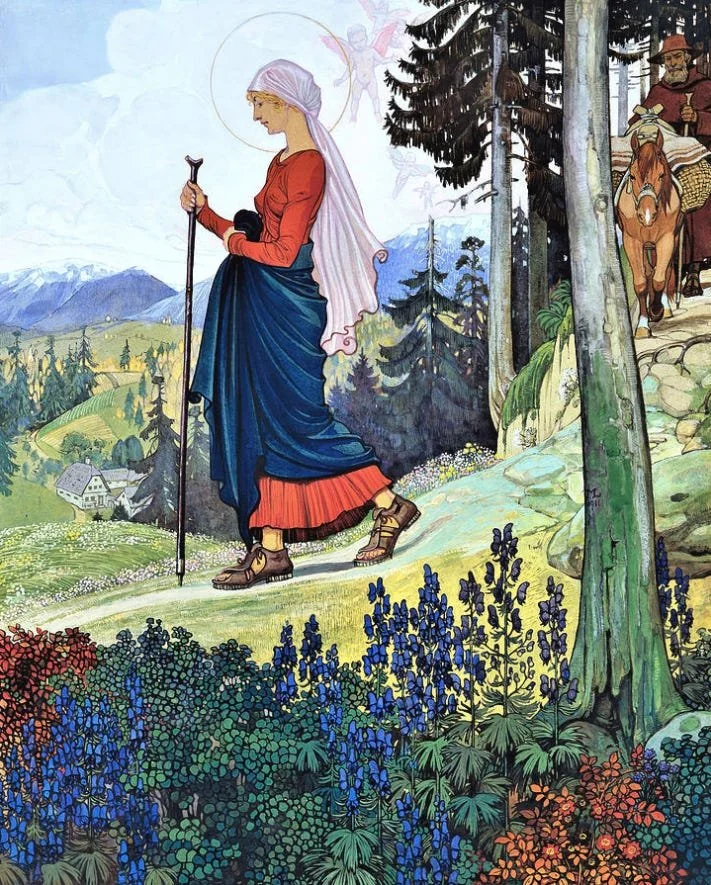
“Walk of Mary Across the Mountains” by Maximilian Albert Josef Liebenwein (1869–1926)

I’m sure we’ve all seen any number of artistic interpretations of the journey of the Holy Family to Bethlehem for the census and the birth of Christ. In most of them, Mary’s fragility as a very-pregnant mother seems to be an important theme: She is typically perched on the couple’s donkey while Joseph tirelessly walks alongside, or is at least leaning heavily on Joseph’s support, if she tries to walk herself. This painting, titled “Walk of Mary Across the Mountains,” struck me as so opposite to those renderings that I first thought – until I noticed Joseph and the burro in the shadows of the upper right-hand corner – that it must be depicting Mary’s visit to Elizabeth, not her trek toward meeting God in tiny-human-baby form.

Perhaps it strikes me especially because I’ve been in this “very-pregnant” state twice in the last six years. I know the immense (perhaps near-impossible) ask that a 70-mile journey on foot would make on an unstable pelvis, split abdominal muscles, and half-capacity lungs. I understand why so many paintings show her riding the donkey – which, granted, wouldn’t have been particularly comfortable, either. Yet in this piece, Maximilian Leibenwein has captured something different in Mary that I also recognize: That state of resigned determination that takes a woman from her already-great discomfort through a period of excruciating travail and into the extraordinary euphoria on the other side.

Toward the end of each of my pregnancies, I didn’t know what scared me more: that I might be pregnant for another three weeks, or that I might not be pregnant for another three weeks. Each option was defined by a different kind of uncertainty and discomfort, but either way, I could not escape the fact that my fate was to endure the uniquely life-upending transition of a birth, sooner or later.

Mary’s baby is coming. The pain is inevitable; the process is inevitable; the birth is inevitable. He is coming. Her body will do the work, and she must only be ready to meet him.

But unique to Mary’s circumstance is that it’s not merely her firstborn son coming; it is her Lord. The Messiah is coming. After millennia of relentlessly inviting his people into his space, God Incarnate invaded ours, bringing heaven to earth and commencing the rebirth of humanity through the birth of Jesus.

Ready or not, the King is coming.

We remember his royal-and-lowly approach in Advent, in part, to remember that the King still approaches us; the King, though come, is also here, and is coming again. He has already-and-not-yet come, already-and-not-yet rescued us, already-and-not-yet glorified us.

How do we approach him? How can we be ready to meet him? Perhaps with a doggedness like Mary’s, as she made the journey toward the “greatly multiplied” pain promised her in Genesis 3:16 for the sake of meeting the snake-crusher of Genesis 3:15. She was at once humble and bold: humble, in her wholehearted submission to God’s use (Luke 1:38); and bold, in her unflinching determination to praise the Lord for the goodness and certainty of his plan for her life, and for her whole people besides (Luke 1:46-55).

We need not have birthed children from our bodies to know what it is to make an arduous trek through certain suffering for the sake of immeasurable joy. This is the story of every saint, every martyr, every follower of Christ – the story of my life and yours. Pain in life, and death at life’s end, are inevitable. But on the other side is Jesus. And with us every moment – though like Mary in Leibenwein’s depiction, we cannot yet see him – is Jesus.

Every day is another step toward the God who has stepped toward us. Every day, a step closer to his presence, a moment nearer to the full realization of his glory. We walk humbly, yet boldly: obeying and praising, walking and singing, enduring and rejoicing. We walk like Mary, across treacherous mountains and valleys of shadow, until at last we see our Lord face-to-face.
approaching God who approaches us

The Advent of the Christ was just a purple candle on a Sunday morning for the first 30 years of my life, and I’m still learning to pause and hold the tension of joy-with-penitence of this “little Lent” before rushing straight into tinsel and carols and holly-jolly cheer the day after Thanksgiving. What is joy with penitence? What does it mean to fast in preparation for a feast, or to sorrowfully reflect while at the same time growing in anticipation for the arrival of the King?

The calendar moves us toward Jesus, toward Christmas. Jesus moves toward us in the miracle of the Incarnation. Heaven and earth are set on a collision-course that will blow up the trajectory of history and should likewise alter the course of our lives. The King is coming, and we are ill-prepared, sin-filled, unworthy to welcome him—sorrow. The King is coming, and He is our loving Father and our salvation—joy.

Advent is like the cool of the day in Eden, that time of the evening breeze when God walked in the garden (Genesis 3:8). His approach would have been pure joy, but for the failures of His imagers. Adam and Eve hide like guilty children waiting to be caught by their parent, unsure what the reaction will be, but expecting it to be bad. Instead of joy, sorrow. Within three pages the whole-goodness of God’s presence for humans has been corrupted by sin, and the whole-joy of His approach has been corrupted by fear.

“Where are you?” (Genesis 3:9b)

“I heard you in the garden, and I was afraid because I was naked; so I hid.” (Genesis 3:10)

I was afraid because I was naked. I was ashamed of myself. I was not worthy to receive you.

We’ve all been there. We reflect for two minutes on the scandal of the Incarnation and we are there: naked, ashamed, unworthy, afraid. How can we approach this God? The instinct is to hide, to lie, to cover ourselves up.

But this glimpse of Advent in Genesis is a glimpse of the joy in our own little Lent, for the King does not laugh at His wayward children; He does not lose His temper; He does not destroy them or abuse them or beat them down. He holds His boundary—and at the same time He covers their shame.

The Lord God made garments of skin for Adam and his wife and clothed them. And the Lord God said, “The man has now become like one of us, knowing good and evil. He must not be allowed to reach out his hand and take also from the tree of life and eat, and live forever.” So the Lord God banished him from the Garden of Eden to work the ground from which he had been taken.

Genesis 3:21-23

We pause in Advent deeply aware of our spiritual nakedness and deeply grateful for God’s generous provision. We can approach Him, unhiding, because He approached us not as a mighty warrior-king but naked and humble Himself, a suffering Servant offering us robes of righteousness. We have a place now in His temple court because He became the fruit of the tree of life by hanging, cursed, on a tree of death.

Of Him we take and eat, and live forever.

delighting in the names of Jesus

A few of you may remember the Advent devotional I created a couple of years ago called “Christ the Lord.” It included twenty-four short devotionals and their corresponding Bible readings regarding twenty-four different titles of the Messiah used in the Scriptures.

It was a joy to meditate on the significance of some of the many, many names used to describe my Jesus as I wrote that study. Then, this past February, I spent two lovely weeks meditating on Him in the very places He walked in the Holy Land. It’s so easy to get caught up in the distractions and overwhelm of everyday life, but these short times of simply delighting in Jesus have been oases of spiritual riches in a couple of rather difficult years.

Those oases inspired me to create something that, maybe, can recapture a taste of those riches and bring us back toward that rest. I’ve bound all twenty-four studies on all twenty-four names of Jesus into a beautiful softcover photo book filled with some of my favorite photographs of the Holy Land - just in time for another journey into the Advent season, but also perfect for any time you need to re-center yourself on who Jesus is and what He has done. It would make a lovely gift, too. In the back, there’s a directory of exactly where in Israel each photograph was taken so that you can take a miniature tour of the Land within these pages.

If you’d like to have one, you can purchase your copy here. I hope it blesses you.

Note: Any proceeds from this devotional will be attributed to the costs involved with keeping this blog up and running.