wilderness God

There’s no escaping the long thread of wilderness (along with its close counterpart, exile) that runs through the Bible from beginning to end. Even before the Creation took shape, there wasn’t nothing—there was wilderness. Chaos, darkness, an untamed place waiting to be forever changed by the breath of God.

Adam and Eve, upon their infamous fall in Genesis 3, were exiled into a wilderness outside the curated Temple Garden that was Eden. Cain, upon murdering his brother, was banished even further out into “the land of wandering.” Humanity was scattered from Babel in confusion; the world was returned to a precreation wilderness state in the flood; Noah and his family became exiles, floating on the chaos waters while it rained for 40 days and 40 nights.

Immediately after being chosen and promised a land, Abraham self-exiled to Egypt, foreshadowing all the times his sons and grandsons and great-grandsons would do similarly: Isaac became a refugee of famine in Gerar; Jacob had to flee his home country for fear of Esau; Joseph, Jacob’s favorite son, was sold into slavery in Egypt and then followed by his father and all eleven brothers when they, too, became exiles because of famine. Moses was banished from his people into the household of Pharaoh for the first 40 years of his life, and then became a sheepherder in the wilderness of Midian for 40 years after that—fleeing the consequences of bloodshed, like Cain. He became the leader of the entire people of Israel out of bondage in Egypt and into . . . yet another wilderness, for yet another 40 years.

This is all just in the first two books of the Bible. We haven’t touched on David fleeing from Saul, or the Babylonian kingdom literally marching the children of Israel into exile in chains, or Jesus going straight from His baptism into the wilderness for 40 days and 40 nights to be tempted by the Adversary.
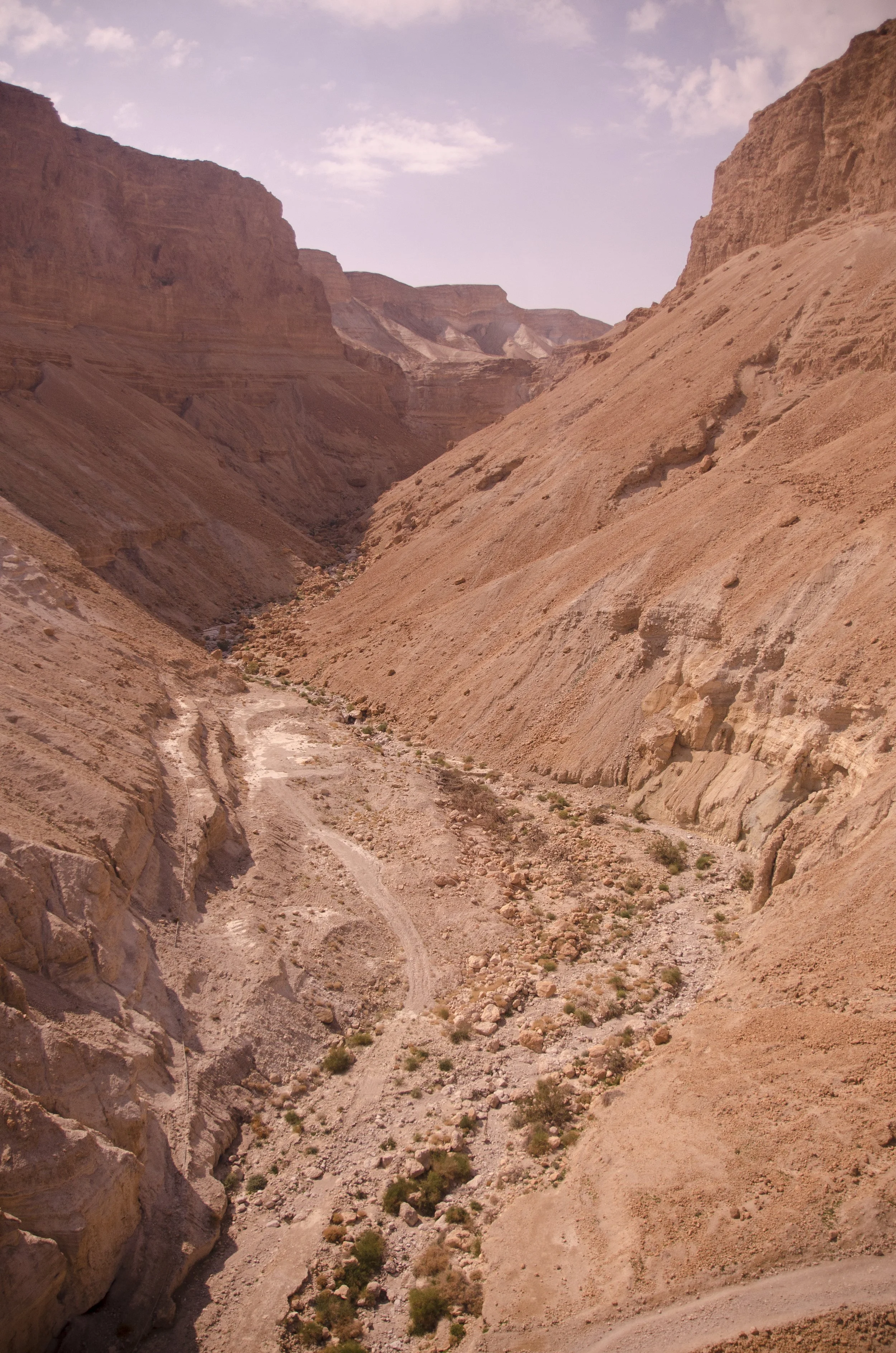
For some reason, the wilderness matters—and not just because it’s evidence of a sin-tainted humanity. Remember, the wilderness was there first.

The Bible calls the first pre-human wilderness not evil, not bad, but “formless” and “void.” It is less than ideal because it’s disordered and not yet what it was meant to be. It’s waiting for something to happen that will fundamentally alter it.

For the breath to hover over the waters (Genesis 1, 8).

For the angel to come and wrestle (Genesis 32).

For the bush to be set ablaze, yet never burned up (Exodus 3).

The wilderness is as key to the plotline of any given human life as it is to the plotline of the Bible, and what the Greater Story tells us again and again is that it is not a place we go alone. When Adam and Eve were sent out from the Garden, we think they were punished by the withdrawal of God’s presence—and yet, in the very next chapter, Cain and Abel are communing with God (Genesis 4). When Cain is banished to the land of Nod, God Himself sets on him a mark of guardianship and protection so that he won’t receive the just desserts of murdering Abel (Genesis 4:15). It’s on the run from Esau that God blesses Jacob (Genesis 28) and on the run from Pharaoh that He gives His personal name to Moses (Exodus 3). He actively leads the children of Israel by fire and cloud out of Egypt and through the Sinai desert (Exodus 13).

All this, from the God who supposedly threw Adam and Eve out of His presence back in Genesis 3.

Clearly, that’s not how it works. He is not only the God of Eden or the God of the Temple.

He is God of the wilderness, too.

When all the people were being baptized, Jesus was baptized too. And as he was praying, heaven was opened and the Holy Spirit descended on him in bodily form like a dove. And a voice came from heaven: “You are my Son, whom I love; with you I am well pleased.” . . . Jesus, full of the Holy Spirit, left the Jordan and was led by the Spirit into the wilderness, where for forty days he was tempted by the devil.

Luke 3:21-22, 4:1-2a

Can you see the beginnings of Creation-over-again? The Spirit over the waters. The Voice from heaven. Jesus, the True Human that Adam and Eve could not be.

And yet the first place He goes is not into the Holy of Holies with God, to the place and status that our first ancestors lost. It’s to the wilderness. And the wilderness, thus occupied by the Trinity, becomes Eden—and Genesis 3 is rewritten with the ending it ought to have had, this time in the desert-made-sanctuary.

We, too, occupy this story, and so even after Christ’s victory we don’t get to live wilderness-free lives. We will all find ourselves in small and great exiles, mini and vast deserts. Chaos and emptiness continue to pock the created world and its history and perhaps, instead of asking why God lets us so suffer, the real question is Why—and how incomprehensible it is!—does God go with us?

We fail, and God follows us out of Paradise.

We sin, and God meets us where we’re hiding.

We are wronged, and God settles in beside us to refute the accusations of the devil.

Our wildernesses become temples because God is there.

“The poor and needy search for water,
but there is none;
their tongues are parched with thirst.
But I the Lord will answer them;
I, the God of Israel, will not forsake them.
I will make rivers flow on barren heights,
and springs within the valleys.
I will turn the desert into pools of water,
and the parched ground into springs.
I will put in the desert
the cedar and the acacia, the myrtle and the olive.
I will set junipers in the wasteland,
the fir and the cypress together,
so that people may see and know,
may consider and understand,
that the hand of the Lord has done this,
that the Holy One of Israel has created it.”

Isaiah 41:17-20

We are not always in the wilderness because of God’s judgment. It’s not always a bad place or the result of evildoing. No, even the Israelites who were exiled to Babylon—which was a judgment—were encouraged to live good lives in their unideal circumstances, to continue to participate in the Edenic vision of creation and kingdom (Jeremiah 29:5-7).

But we are always meant to be looking, praying, waiting for the Wilderness God to make a move.

Divine breath. A dream. A fight. A burning bush. The Holy Spirit, the very presence of God.

You’re still standing in the same place, but suddenly this wasteland is holy ground. Maybe there’s even water, or a green thing growing, a sign of life.

Maybe you are being made new.

“Forget the former things;
do not dwell on the past.
See, I am doing a new thing!
Now it springs up; do you not perceive it?
I am making a way in the wilderness
and streams in the wasteland.”

Isaiah 43:18-19

truth and beauty

I wish I had music in my soul. It seems easier to put voice to it all that way, to put the hard unbeautiful words into some beautiful form that goes down easier. You can say more while saying less and the critics are too busy nitpicking the sound to go hard against the lyrics.

Plain words in a plain paragraph form, like this, leave nowhere to hide. I tell you what I think and wait to be torn to shreds for it. I write prose for the same reason people write poetry, but without the poetic form to excuse my emotion as “art.” Mine will be dismissed as the emotions of a weak vessel, but if this were a song the emotions would be considered its life force.

The feelings are allowed in art.

No wonder art has lost its place in church.

There’s at least some small exodus from Evangelicalism, Inc., with its warehouse buildings and windowless sanctuaries, back into traditions that lean into rhyme, rhythm, color, and beauty along with the truth. To my surprise, I have joined it.

If you follow my life in a timeline of the churches I’ve been part of, you’ll find that I followed the light: from four different windowless warehouses with bare walls to migrating into the well-lit foyer to, finally, sitting down every week in a cozy former synagogue with tall windows down each side, sunlight pouring generously in. There are small reproduced paintings in between the window frames depicting various Biblical scenes, and colorful banners hang on the walls. The altar is draped in rich fabric according to the liturgical season. Candles flicker. It’s humble, and it’s beautiful.

The feelings are allowed in beauty.

Truth and beauty are two of my highest values, but they’ve always felt at odds with each other. In this culture, we use phrases like “the awful truth” or “the ugly truth”—the thing nobody wants to hear, but somebody has to be brave enough to say. Those who offend with the truth get recognition. For several years, I tried this tactic on for size in my own writing, and it worked; it got a lot of comments and shares and traffic. It felt like I was doing something that mattered.

But it was ugly. Marked by pride, flattery, ego, and conflict. Even if everything I wrote was true, very little of it was honest.

Honesty is where truth and beauty find overlap.

The feelings are allowed in honesty.

In the realm of Christianity I’ve spent the most time in, there is this unspoken idea that the only really-true truth is the one that has been stripped of every element of life. “Real” truth, Truth with a capital T, should sound like a mathematical fact or a scientific law: black and white and unarguable and entirely dismissive of complicating factors like God or relationship or humanity.

Any emotion or soul or spirit—even the Holy Spirit Himself—renders a truth-claim suspect.

It’s idiotic, really. We were made human, in the image of God, only to attempt to become robots in how we discern what is true. We’ve made a sort of idol out of certainty—out of being able to believe a “fact” simply because “God said so,” without regard for the creative evidence both within us and without us that screams our facts are at best incomplete. Our truth is not honest.

If we are honest, humans were created for beauty. Humans are wired for emotions. Humans thrive in relationship. If we’re honest, relationships and emotions are some of the messiest and grayest areas of life. You can’t slap a mathematical fact or a scientific law on any of it. It’s just too unpredictable.

To me, that’s why it’s beautiful.

It’s a glimpse of God at work—glorious, fierce, incomprehensible. It’s a reminder that I am not in control and I don’t get to tell Him who He is. It’s walking under the trees in a whipping wind while the sky roils with thunderheads, or lying in the grass with the sun on your face and the thin buzz of honeybees all around. It’s the familiar rhythm of spring rolling into summer or the phases of the moon, punctuated by the chaos of invisible solar storms or devastating natural disasters.

There is order and there is chaos. There is truth and there is beauty. There is body and there is emotion. There is what we know and a whole universe of what we don’t know at all.

Honesty—the space where truth and beauty overlap—is what I see at the heart of the exodus from warehouse to window-light. I, for one, am worn out by robotic certainty and “the ugly truth,” because I know that the honest truth, the truth that holds space for the divine as well as the human, is beautiful.

God is beautiful and the maker of beauty. God is true and the standard of truth. My job, as His image-bearer and witness, is honesty.

on -ologies

I didn’t always know I wanted to be a parent. In fact, for the first 25 years of my life, I didn’t want to be a parent, and I felt some shame about that as a young Christian wife. I jokingly credit my change of heart at age 25 to the good old-fashioned biological clock, but maybe there was a nudge of the Holy Spirit in it as well, because it turns out that having kids has changed my life (shocker!).

I probably say to myself at least once a day, “I can’t do this.” And I truly was not built for it. I’m extremely auditory-sensitive and my children are both very loud. Clara barely stops talking to take a breath from sunup to sundown, and Jane communicates each of her feelings in a different pitch of yell or shriek. My nervous system gets a workout every single day.

They don’t know it, but it’s through my two daughters that I have also found sanctuary for my soul—internal, quiet, rest.

How? Because they have shown me who God is.

All the years that I spent reading and studying the Scriptures before I had children were good and edifying, but all that propositional knowledge merely laid the foundation for finally experiencing what is true. In parenthood, I get the palest glimpse into the reality of God as a father who lavishes love on His children and a mother who gathers her chicks under her wings. The Gospel is no longer a one-dimensional story about how I can “get out of hell free”—it’s the good news of victory, that the Creator of heaven and earth has resoundingly defeated sin and death so that both realms can be united again as His kingdom and I can be part of it, because—what is this miracle?!—He wants me there.

I have met God the Rescuer, and He is good.

I have met God the Redeemer, and He is good.

I have met God the Nurturer, and He is good.

I have met the King, and to my amazement, He’s not a control freak. He’s not obsessed with punishment, retribution, or how my behavior reflects on Him. He is the Prince of Peace, gentle and lowly. He delights in me and the thoughts and reflections I share with Him the same way I delight in everything Clara and Jane are learning and doing each day.

Sometimes I think we get so lost in theology and terminology that we forget to look for God Himself, and hesitate to let Him be God when He colors outside our preconceived lines.

I understand it—the fear of being flippant with the truth, or defining who God is based on the narrow parameters of how we feel or what we experience. Those things can never give us a complete picture. But what can? Do we expect that any of us will find our picture of God to be perfectly accurate when we meet Him face to face, regardless of whether we know the “right” theology, soteriology, eschatology, or other -ology?

My hope for that day is that I’ll have more than a picture; I’ll have a relationship.

A picture might give me some facts so I can recognize Him when I see Him, but the relationship is what I can take deeper and deeper into eternity. The relationship is what transforms me into His likeness. The relationship is where everything I know to be true about Him actually becomes true in my life.

It wouldn’t do my children much good to be raised by a portrait of me. To know my philosophy on parenting or my stance on discipline or even a disembodied fact about how much I love them.

None of it matters unless they get to live in the reality of it, a living and breathing and dynamic two-way relationship.

The Bible depicts God’s connection with His children as that of a breastfeeding mother with her baby, and there are few relationships as real, experiential, and vital as the mother-baby dyad. Facts and depictions can’t feed, comfort, hold, warm, support, love, and sustain a life. The baby deprived of any of those experiences, let alone all, would fail to thrive.

Human experience doesn’t live on the pages of books or the lines of doctrine. And God doesn’t fit there, either.

I am reminded of the words of James that used to make me feel so uncomfortable:

But someone will say, “You have faith, and I have works.” Show me your faith without works, and I will show you faith from my works. You believe that God is one; you do well. The demons also believe—and they shudder.

James 2:18-19

Rather than contradicting salvation by grace, as my younger self often worried, these words underscore my point: Knowing a certain set of facts is not evidence of faith. I’d argue that most of the underworld knows a lot more information, and more accurately, about God than any human on earth. It doesn’t make them His disciples.

Facts and information don’t create disciples any more than they raise babies.

A friend of mine went through a multi-year health crisis which impacted her so much that she couldn’t do anything, including go to church or read her Bible or spend time with other believers. For several years she passed her days mostly alone in her room, with little more stimulation than the view of tree branches from her window.

But the Holy Spirit communed with her there.

Her story has led me to reflect on the substance of my own walk: I love the Scriptures deeply, but suppose all my Bibles and Bible study resources were suddenly no longer available to me?

In relationship with the Triune God, the Word-Made-Flesh would still dwell with me. God would still be Father to me. The Holy Spirit would still animate me.

All the -ologies in the world can’t compare with that.

“And the Father who sent me has given evidence about Me. You’ve never heard His voice; you’ve never seen His form. What’s more, you haven’t got His Word abiding in you, because you don’t believe in the one He sent.

“You study the Bible,” Jesus continued, “because you suppose that you’ll discover the life of God’s coming age in it. In fact, it’s the Bible which gives evidence about Me! But you won’t come to Me so that you can have life.”

John 5:37-40, The Kingdom New Testament