mad, but

One of my favorite retellings of the Cinderella story is the 1998 Drew Barrymore film Ever After. It’s the source of many of the random quotes and sayings I use in my everyday life, but one line of Prince Henry’s has always struck a particular chord with me:

“I used to think that if I cared about anything, I’d have to care about everything, and I’d go stark-raving mad. But! Now I’ve found my purpose.”

I exist in the middle of that quote—somewhere between the word “mad” and the word “but.” One of the hardest things about writing (essentially, publicly journaling) for the last 14+ years has been the pressure I constantly feel to cover everything, to respond to everything, to consider everything. Whether I’m writing about a lightbulb moment I’ve had regarding God’s purpose for the church, a line-by-line study of a chapter of the Bible, or a meandering musing inspired by some little snippet of my life, it’s easy to feel like I’m wasting my time if I can’t head off every potential argument or acknowledge every possible perspective.

And it does, indeed, make me feel stark-raving mad.

It reminds me of something I heard another writer I admire say in an interview recently: “You have to be willing to disappoint your biggest fans, or else you’ll become a caricature.” This, to me, intersects with the Ever After quote right at the end—in the words “my purpose.”

My purpose.

What I’m learning, painfully slowly, is that I’m an individual. I’m small. I’m one person living one life in one comparatively tiny radius on the earth. When I write, I can only write what God is showing me. I can only show you how He’s shaping me. Inevitably, my limits will disappoint you eventually.

I can’t speak for every person or cover every experience. Even on topics in which I’m well-versed, I can’t address every point or counterpoint. There just isn’t enough of me.

I love that there are so many people who support my writing and enjoy reading my work. It’s a humbling and, at times, terrifying realization. What a gift it is to be able to write anything at all that somebody else out there might glean a grain of truth or insight from.

And, with all the love in the world, I confess: I don’t write for “fans.” I write because this is how I learn, and I’m learning to follow God’s Spirit and listen to His voice. I’m learning to let Him define my purpose, and that it’s okay if my calling doesn’t resonate with yours.

I know how hard it is, when you enjoy someone’s work or admire their gifts, to keep a separate sense of self from them—so that when they change their mind on something, it’s okay if you don’t; or when God is revealing something to them, it’s not a commentary on what He’s revealing to you. We tend to admire people we identify with or aspire to be like, and it can feel personal when they go in a direction that we can’t or won’t—but it isn’t.

You can still learn from those you don’t perfectly align with. I can still love those I don’t agree with. We can still be enriched by those whose lives are in a very different place from ours. And because we are all just individuals, with our small and limited perspectives, we need that diversity of thought in our lives. To know anything doesn’t mean we have to know everything.

There is only One who is omniscient. There is only One who has it all right. As Rich Mullins once said (oft-quoted by my mom and dad), “We were given the Scriptures to humble us into realizing that God is right, and the rest of us are just guessing.”
inner earthquakes and hellfire

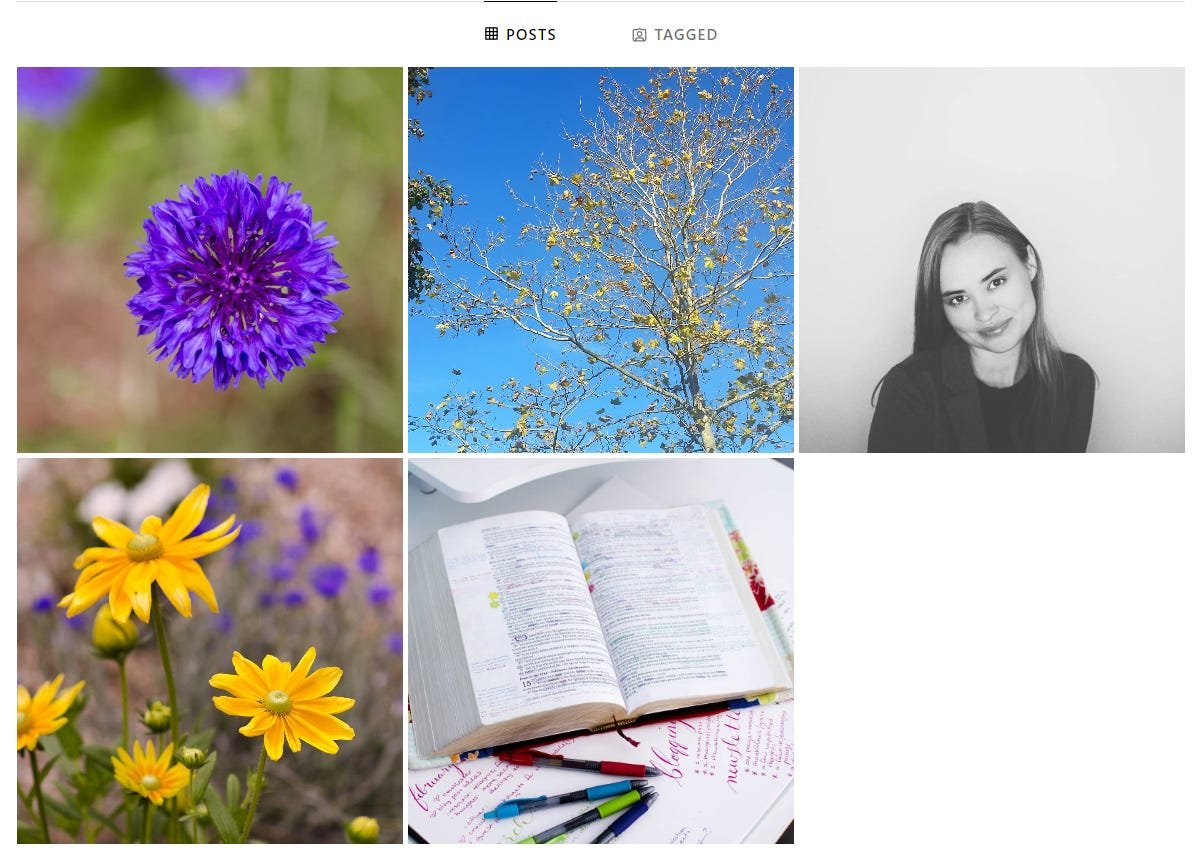
Today I resurrected the old @halliewrites Instagram account that I started about six years ago, right when I was working hard on my first book and building up a community around the Bible180 Challenge. I was 24 years old, had been married four years, and had no children. These were only the earliest days of Instagram stories and reels didn’t yet exist, so the entirety of my presence can be found in a handful of photo posts with captions. Looking back at those posts, for me, is like a glimpse into the story of a young woman I met once, but barely remember.

But because I lived it, I can read the paragraphs in between the posts that the true outside observer will never see.

Can you tell that in the space between the first post and the second, the life I thought I had exploded?

Do you sense that between the colorless self-portrait and the phone camera snap of the last autumn leaves, I nearly gave up and walked away?

And in the caption beneath the bachelor button at the top of the grid—dated June 8, 2019—can you hear the shaking breaths of someone who survived, but still desperately fears that a survivor is all she will ever be again?

I may barely remember that person, but I will never forget that fear. I thought I had been permanently shelved, sidelined by God, and that I was doomed to waste the rest of my life because what I believed were my best years had been ruined by grief. If I wasn’t going to get to change the world as a young, free, childless Proverbs 31 wife, when would I ever have the chance?

But what I said in that caption rings true: “God works slowly. He’s a farmer, not a magician.”

I’ve aged 5 years and had two babies since then. I’ve continued to write, even though many times it seemed pointless. And I’ve been learning that no one changes the world without first navigating the earthquake within themselves.

I think I am just now learning to yield to the seismic shifts of the Holy Spirit in me. I don’t expect to be out there massively changing the world anytime soon, especially since the world that’s most important to me right now is that of my 3-year-old and my 6-month-old. But my heart is overflowing with thanksgiving for God’s grace and goodness that has gone with me at every step, even when I was sure He was the one trying to lead me over the edge.

I’m so thankful that I was born in the year 1994. A little earlier, and I’m fairly certain I would have been caught in the farce of idealistic Christian mommy blogging, hot on the heels of extreme purity culture. A little later, and I would have been buying into the deceptive appeal of today’s “tradwife” crowd. I missed them both by just a little, and thank God.

I’m so thankful I got married at 20 years old. Although processing through the sense that I couldn’t really have a fair choice in the matter at such a young age has been fraught, I know that God was gracious to teach me some very important things a lot earlier than I might otherwise have had the opportunity to learn. I lost less of my life to the lies.

I’m so thankful I married the person I did. I can’t imagine anyone else being able to weather these existential storms with me so humbly. The Holy Spirit is leading us as we walk after Christ together, side by side, and there is nothing more gloriously kingdom-of-heaven-like than that.

I praise and glorify God my Father that He did not allow me to stay the same, even when the process of change felt like traversing hellfire. His vision for me has been far greater, in the real and important ways, than my vision for myself ever was.

for yonder breaks

What do you see in the picture above?

Is it an all-seeing eye? Or is it an eerie black cave?

It’s both.

When I was about three years old, the same age as my daughter Clara, I remember the power going out in the middle of the night. We lived in a double-wide mobile home in the middle of nowhere, so when the power went out on a moonless night, it was darkness like most of us never see anymore. I couldn’t see my own hand in front of my face, and I was scared—terrified. I could only think of one thing to do: Get to my mom and dad’s room, because with them, I’d be safe.

Very carefully, I slid out of bed. My bedroom was tiny, and I figured it wouldn’t be too hard to map my way to the doorway. A few steps forward, then a right turn, a few more steps—and I’d be out in the hall. From there I would just have to make it straight across the living room to my parents’ bedroom door.

Step, step, step. Turn. Step, step—bang.

It wasn’t my doorway I had found. It was bars. Vertical bars, like a jail. I gripped one in each hand and felt my whole body seize silently with terror. They had locked me in. I couldn’t escape this horrible dark place. I was trapped.


This memory resurfaces often for me, usually at random and without much emotion attached. I’ve always wondered why it stuck with me so clearly for so long—until I realized recently, with some guidance from my counselor, that even though this event occurred nearly 27 years ago, I have unconsciously relived it about a thousand times since.

When my idealistic illusions of my marriage shattered—trapped. When I was sitting in the Neuro ICU waiting room for what felt like days on end—trapped. When I had a newborn baby and postpartum depression—trapped. When I sat in church community groups in disagreement, yet unable to speak—trapped.

Most recently, when I had to force-feed my too-small baby who was always happy except when she was eating, but had to eat for the sake of her own development: Trapped.

My counselor said I might benefit from what she called “memory work.” It’s where you return to the memory and relive it as realistically as you can. While you’re there, you seek until you find where God was in that moment—where the Father, Son, and Holy Spirit were in the scene with you.

I tried, but I felt handicapped by my logical mind. I’d try to feel the bars in my hands and I’d hear my left-brain saying, “This isn’t going to work. You know you’re not actually there.” So I tried something else my counselor has suggested before as a bridge into my right-brain: art.

The picture above began with my paintbrush dipped in black. I painted the black of that room where I had felt so trapped, the choking quality of an unfathomable darkness. I added other colors and shapes and concepts as the memory stirred me. And when the picture was complete, I finally discovered where God had been—or maybe more accurately, where I was in relation to God: In the center of His eye all along.


My dad came down the hall carrying a candle. His voice was gentle and reassuring. I could see, finally, in that dim and flickering light, that the bars I thought were a jail they’d put up to contain me were just the railing of my sister’s crib. I had miscalculated my steps and never reached the door.

I think my joy and relief to see that faint glow of light and Dad’s face must be something like what Creation felt when the baby Jesus drew His first human breath.

A thrill of hope.

Maybe I wasn’t truly trapped. Maybe they did really love me. Maybe I wouldn’t be stuck in the dark by myself forever.

Maybe, even though all I could see was darkness, I was actually enveloped on all sides by the dazzling embrace of a loving and compassionate God.

O holy night! the stars are brightly shining;
It is the night of the dear Savior’s birth.
Long lay the world in sin and error pining,
Till He appeared and the soul felt its worth.
A thrill of hope—the weary world rejoices,
For yonder breaks a new and glorious morn!
Fall on your knees! O hear the angel voices!
O night divine, O night when Christ was born!

- O Holy Night by Placide Cappeau (translated by John S. Dwight), 1847